

What is class 3 obesity? The different obesity classes explained
Ready to take the next step? See if you're eligible for expert-led weight loss support.
What, exactly, is class 3 obesity? What about class 1 and class 2? Learn about the different obesity classes and what they mean for our health.
Obesity is a global health concern.
Worldwide, the number of adults living with obesity has doubled since 1990.¹ And the most recent Health Survey for England estimates that 28% of adults in England are living with obesity. A further 36% are overweight.²
Class 3 obesity (also referred to as 'severe obesity') is particularly concerning to medical professionals. That's because this class is the most severe and carries the highest risk of weight-related issues like type 2 diabetes and heart problems.
Experts predict that almost five million people will be living with class 3 obesity across England, Scotland and Wales by 2035.³ This is more than just a worrying statistic. It represents a huge impact on people's lives and significant pressure on our health services.
So, what does class 3 obesity mean – and what's the difference between class 1, class 2, and class 3 obesity? To explain that, we first need to look at BMI: the standard measure of obesity.
How do doctors determine whether someone has obesity or is overweight?
Doctors in the UK use body mass index (BMI) to determine whether a person is overweight or has obesity.
You can calculate a person's BMI by dividing their weight in kilograms by the square of their height in metres. For example, 23kg/m2 would be a BMI score of 23.
That's because everyone carries weight differently. Gender, age, ethnicity and body structure should also be considered alongside the BMI calculation.
Limitations of BMI
The National Institute for Health and Care Excellence (NICE) recommends that doctors use clinical judgement when interpreting the healthy weight category.⁴ This is because a person may have a healthy BMI but still have
central adiposity
(fat around the abdomen).
People of South Asian, Chinese, other Asian, Middle Eastern, Black African or African-Caribbean descent are particularly prone to central adiposity. That puts them at a higher risk of health problems at a lower BMI.
What is central adiposity, or abdominal obesity?
Ever heard of the 'apple body shape'? This is one characteristic of central adiposity – the accumulation of fat around the abdomen.
Worldwide, the number of adults living with obesity has doubled since 1990.¹ And the most recent Health Survey for England estimates that 28% of adults in England are living with obesity. A further 36% are overweight.²
Class 3 obesity (also referred to as 'severe obesity') is particularly concerning to medical professionals. That's because this class is the most severe and carries the highest risk of weight-related issues like type 2 diabetes and heart problems.
Experts predict that almost five million people will be living with class 3 obesity across England, Scotland and Wales by 2035.³ This is more than just a worrying statistic. It represents a huge impact on people's lives and significant pressure on our health services.
So, what does class 3 obesity mean – and what's the difference between class 1, class 2, and class 3 obesity? To explain that, we first need to look at BMI: the standard measure of obesity.
How do doctors determine whether someone has obesity or is overweight?
Doctors in the UK use body mass index (BMI) to determine whether a person is overweight or has obesity.
You can calculate a person's BMI by dividing their weight in kilograms by the square of their height in metres. For example, 23kg/m2 would be a BMI score of 23.
- A healthy weight falls between 18.5 and 24.9
- Overweight is 25 to 29.9
- With a BMI of 30 or more, a person is considered to have obesity
That's because everyone carries weight differently. Gender, age, ethnicity and body structure should also be considered alongside the BMI calculation.
Limitations of BMI
The National Institute for Health and Care Excellence (NICE) recommends that doctors use clinical judgement when interpreting the healthy weight category.⁴ This is because a person may have a healthy BMI but still have
central adiposity
(fat around the abdomen).
People of South Asian, Chinese, other Asian, Middle Eastern, Black African or African-Caribbean descent are particularly prone to central adiposity. That puts them at a higher risk of health problems at a lower BMI.
What is central adiposity, or abdominal obesity?
Ever heard of the 'apple body shape'? This is one characteristic of central adiposity – the accumulation of fat around the abdomen.
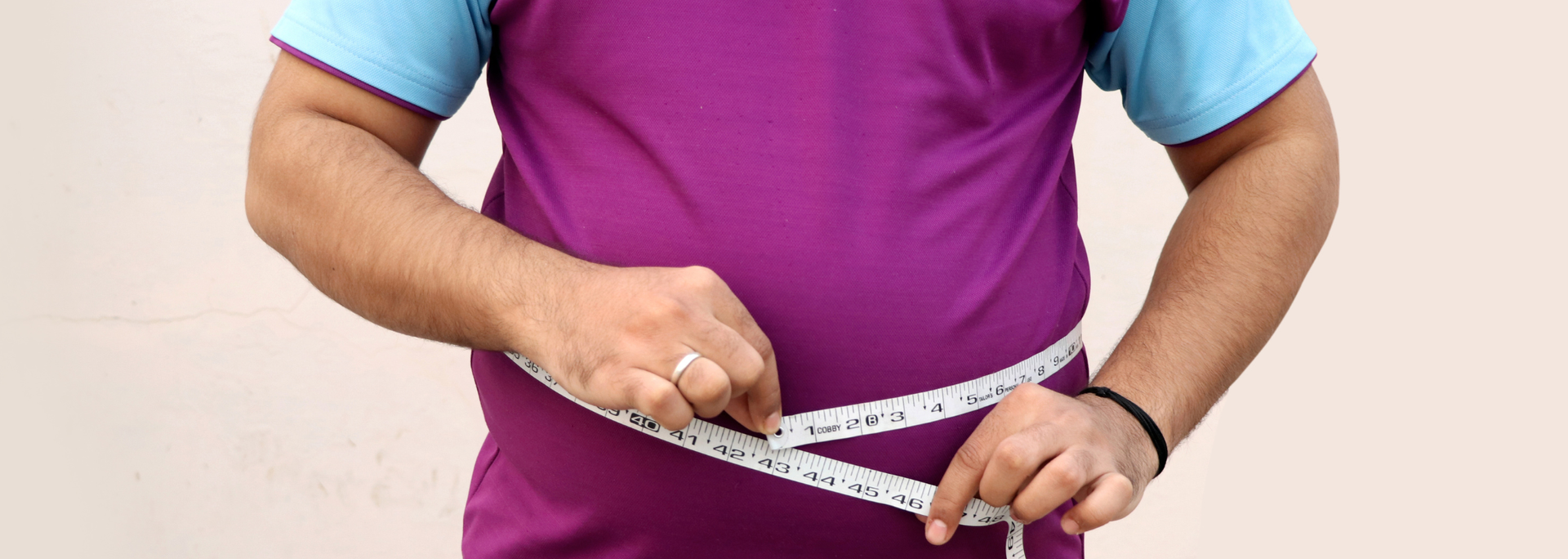
Even in a healthy BMI bracket, having central adiposity increases your risk of type 2 diabetes, hypertension and cardiovascular disease. Medical practitioners often measure central adiposity alongside BMI to make better, more personalised predictions for a patient's risk of weight-related health problems. They measure this using:
Why we need classes of obesity
The problem of central adiposity demonstrates one of the major flaws of BMI: it can't paint a full picture of a person's health.
As we've seen, people with a BMI in the healthy weight category can still be at risk if they have central adiposity. The BMI calculation is simply too imprecise to pick up on this health risk.
The same is true at the other end of the scale. Often, anyone with a BMI of 30 or greater is simply labelled as 'obese'. However, this isn't enough to understand what challenges they might be experiencing in their daily lives, or their health risks.
What are the three obesity classes?
Based on a person's BMI results, obesity is further defined into three different classes depending on severity.
- Waist circumference
- Waist-to-hip ratio
- Waist-to-height ratio
Why we need classes of obesity
The problem of central adiposity demonstrates one of the major flaws of BMI: it can't paint a full picture of a person's health.
As we've seen, people with a BMI in the healthy weight category can still be at risk if they have central adiposity. The BMI calculation is simply too imprecise to pick up on this health risk.
The same is true at the other end of the scale. Often, anyone with a BMI of 30 or greater is simply labelled as 'obese'. However, this isn't enough to understand what challenges they might be experiencing in their daily lives, or their health risks.
What are the three obesity classes?
Based on a person's BMI results, obesity is further defined into three different classes depending on severity.
What is class 3 obesity?
Class 3 obesity is the most severe form of obesity. In fact, it's sometimes known as 'severe obesity'. In the past, it was often called 'morbid obesity'. However, this term is considered stigmatising and is used less frequently nowadays.
As you might imagine, people living with class 3 obesity face the greatest weight-related health risks. What you might not know, however, is that people with class 3 obesity find it harder to get the support they need.
Prevention is still the primary target for obesity management. However, once a person develops class 3 obesity, 'it becomes increasingly difficult for them to achieve substantial and sustained weight loss without intervention'.⁵
Access to NHS treatment is the number one issue faced by patients in the UK. As of May 2024, there were 8,000 people on the NHS waitlist for bariatric (weight loss) surgery. These patients faced wait times of one to two years.⁵

Bariatric surgery is available privately from providers like
Phoenix Health
. But what if a person living with class 3 obesity doesn't want to consider bariatric surgery or needs to improve their health while they wait?
In cases like this, the new generation of injectable weight loss medications can be potentially game-changing.
H3: How weight loss injections can help
The good news is that, no matter which obesity class you fall under, losing weight in a sensible and sustained way is very much possible.
The once-weekly injectable medications Wegovy and Mounjaro can help. These work by slowing down digestion and controlling blood sugar. This leads to:
Both treatments are available on prescription to people living with obesity, following consultation with a trusted provider like SemaPen.
H3: Start your weight loss journey with SemaPen
Whether it's class 1, class 2 or class 3 obesity, we know that being given a label can cause a lot of complex emotions.
It's important to remember that these terms are designed to help make medical treatments for obesity more effective. By better understanding the problems a person might face based on their obesity class, we can deliver better, more targeted medical care.
This focus on targeted treatments is central to what we do at SemaPen. We tailor our treatments to you because we know that no two people and no two weight loss journeys are the same.
When you complete our digital consultation , we'll assess your information and recommend the right approach based on your unique needs and medical history. That might be:
Sources
1. World Health Organization (2025) Obesity and overweight. Retrieved from https://www.who.int/news-room/fact-sheets/detail/obesity-and-overweight
2. UK Parliament (2025) Research Briefing: Obesity statistics. Retrieved from https://commonslibrary.parliament.uk/research-briefings/sn03336/
3. Keaver, L. et al. (2020) "Morbid obesity in the UK: A modelling projection study to 2035" Scandinavian Journal of Public Health , 48(4) https://doi.org/10.1177/1403494818794814
4. National Institute for Health and Care Excellence (2025) Obesity: How should I confirm if a person is overweight or obese? Retrieved from https://cks.nice.org.uk/topics/obesity/diagnosis/identification-classification/
5. Byrne, J. (2024) "Severe obesity and current treatment in the UK: a call for radical reshaping of services" The Bulletin of the Royal College of Surgeons of England , 106(6) https://doi.org/10.1308/rcsbull.2024.108
6. Wilding, J.P.H. et al. (2021) "Once-weekly semaglutide in adults with overweight or obesity" The New England Journal of Medicine, 384(11) https://doi.org/10.1056/NEJMoa2032183
7. Jastreboff, A.M. et al. (2022) "Tirzepatide Once Weekly for the Treatment of Obesity" The New England Journal of Medicine, 387(3) https://doi.org/10.1056/NEJMoa2206038
This article was reviewed and approved by Lujain Alhassan, Bariatric Dietitian, and Sarah Abdula, Specialist Dietitian, on 27 November 2025.
In cases like this, the new generation of injectable weight loss medications can be potentially game-changing.
H3: How weight loss injections can help
The good news is that, no matter which obesity class you fall under, losing weight in a sensible and sustained way is very much possible.
The once-weekly injectable medications Wegovy and Mounjaro can help. These work by slowing down digestion and controlling blood sugar. This leads to:
- A reduced appetite
- Fewer snack cravings
- Feeling full for longer after eating
Both treatments are available on prescription to people living with obesity, following consultation with a trusted provider like SemaPen.
H3: Start your weight loss journey with SemaPen
Whether it's class 1, class 2 or class 3 obesity, we know that being given a label can cause a lot of complex emotions.
It's important to remember that these terms are designed to help make medical treatments for obesity more effective. By better understanding the problems a person might face based on their obesity class, we can deliver better, more targeted medical care.
This focus on targeted treatments is central to what we do at SemaPen. We tailor our treatments to you because we know that no two people and no two weight loss journeys are the same.
When you complete our digital consultation , we'll assess your information and recommend the right approach based on your unique needs and medical history. That might be:
- An injectable drug for weight loss , such as Wegovy or Mounjaro
- SemaHealth – our dietitian-led meal replacement programme
- For those who most need it, bariatric surgery performed by trusted UK surgeons
Sources
1. World Health Organization (2025) Obesity and overweight. Retrieved from https://www.who.int/news-room/fact-sheets/detail/obesity-and-overweight
2. UK Parliament (2025) Research Briefing: Obesity statistics. Retrieved from https://commonslibrary.parliament.uk/research-briefings/sn03336/
3. Keaver, L. et al. (2020) "Morbid obesity in the UK: A modelling projection study to 2035" Scandinavian Journal of Public Health , 48(4) https://doi.org/10.1177/1403494818794814
4. National Institute for Health and Care Excellence (2025) Obesity: How should I confirm if a person is overweight or obese? Retrieved from https://cks.nice.org.uk/topics/obesity/diagnosis/identification-classification/
5. Byrne, J. (2024) "Severe obesity and current treatment in the UK: a call for radical reshaping of services" The Bulletin of the Royal College of Surgeons of England , 106(6) https://doi.org/10.1308/rcsbull.2024.108
6. Wilding, J.P.H. et al. (2021) "Once-weekly semaglutide in adults with overweight or obesity" The New England Journal of Medicine, 384(11) https://doi.org/10.1056/NEJMoa2032183
7. Jastreboff, A.M. et al. (2022) "Tirzepatide Once Weekly for the Treatment of Obesity" The New England Journal of Medicine, 387(3) https://doi.org/10.1056/NEJMoa2206038
This article was reviewed and approved by Lujain Alhassan, Bariatric Dietitian, and Sarah Abdula, Specialist Dietitian, on 27 November 2025.
- Average 15-21% weight loss*
- Tailored programmes built by real experts
- Targeted support to make success feel simpler
- Unique app with weight loss tools and lessons
Your journey starts here
Start your personalised weight loss plan in minutes.
1
Start your online consultation
2
Get approved by our clinical team
3
Begin your programme

Wondering if weight loss can cause depression? The simple answer: it depends on how you do it.

Obesity is a leading cause of obstructive sleep apnoea. Does that mean weight loss injections can help? Let's look at the evidence.
Wondering where you'll notice weight loss first? Discover the early signs of fat loss and why it's worth celebrating achievements beyond the scale.

A recent trial tested Wegovy for weight loss in children aged 6 to 11. Does that mean younger children will soon be able to access the drug?

Retatrutide is an experimental weight loss drug that's not approved for treatment anywhere. So, why are websites offering it for sale in 2026?

Explore the fastest medically supervised weight loss options, from GLP-1 injections to total diet replacement, and learn why speed isn't everything.

Non-surgical weight loss procedures may help you lose weight without conventional surgery. Learn about your options and which might suit you.

A new GLP-1 drug called 'avexitide' is in development, but it works very differently from Wegovy and Mounjaro. Get the facts in our guide.
Learn how medically supervised total diet replacement (TDR) programmes work, who they're suitable for and what the evidence says.

Learn who total diet replacement programmes are designed for, how they work and whether they could support your weight loss goals.

