
GLP-1s: how much weight do you need to lose to stop treatment?
Ready to take the next step? See if you're eligible for expert-led weight loss support.
Reached your goal weight on Mounjaro or Wegovy? Learn how weight, BMI and health status can help determine when to stop treatment.
When you start taking a weight loss injection, it's natural to have a goal in mind.
Maybe it's a number on the scales. Perhaps you'd like to get below a certain BMI, fit comfortably into your favourite clothes again or simply do more of the activities you enjoy.
But what happens when you reach that goal? Does hitting your target mean it's time to stop taking Mounjaro or Wegovy?
Not necessarily.
There's no agreed amount of weight you need to lose before stopping GLP-1 treatment. That's partly because everyone's starting point is different, but also because weight isn't the only way to measure whether treatment has been successful.
For some people, reaching their goal weight marks the point where treatment moves from weight loss to weight maintenance. For others, stopping might make sense. It's a decision to make with your healthcare team based on your health, progress and individual goals.
Is there a target amount of weight I should lose?
There's no universal target.
You may have heard the figure 'five percent of your starting body weight' used in relation to medications like Wegovy and Mounjaro. But it's important to understand what that number actually means.
Five percent is commonly used as a treatment response threshold. In other words, it helps healthcare professionals judge whether a weight loss medication is working well enough to justify continuing it.
For Mounjaro, current NICE guidance says that
- if you've lost less than five percent of your initial body weight after six months, and
- you're on the highest dose you can tolerate
then you and your healthcare team should review whether continuing treatment makes sense. Similar guidance applies to Wegovy.¹
So, let's say you start treatment at 100kg. Five per cent of your starting weight would be five kilograms.
Losing those five kilograms doesn't mean you've reached the end of treatment. Quite the opposite: it may simply demonstrate that you're responding to it.
How much further you want or need to go will depend on your individual circumstances.
What should my goal weight be?
Some people start treatment with a very specific number in mind. Others don't – and that's fine.
A sensible goal should take into account more than what you used to weigh or what you think you 'should' weigh.
Your healthcare team might consider things like:
- Your starting weight and BMI
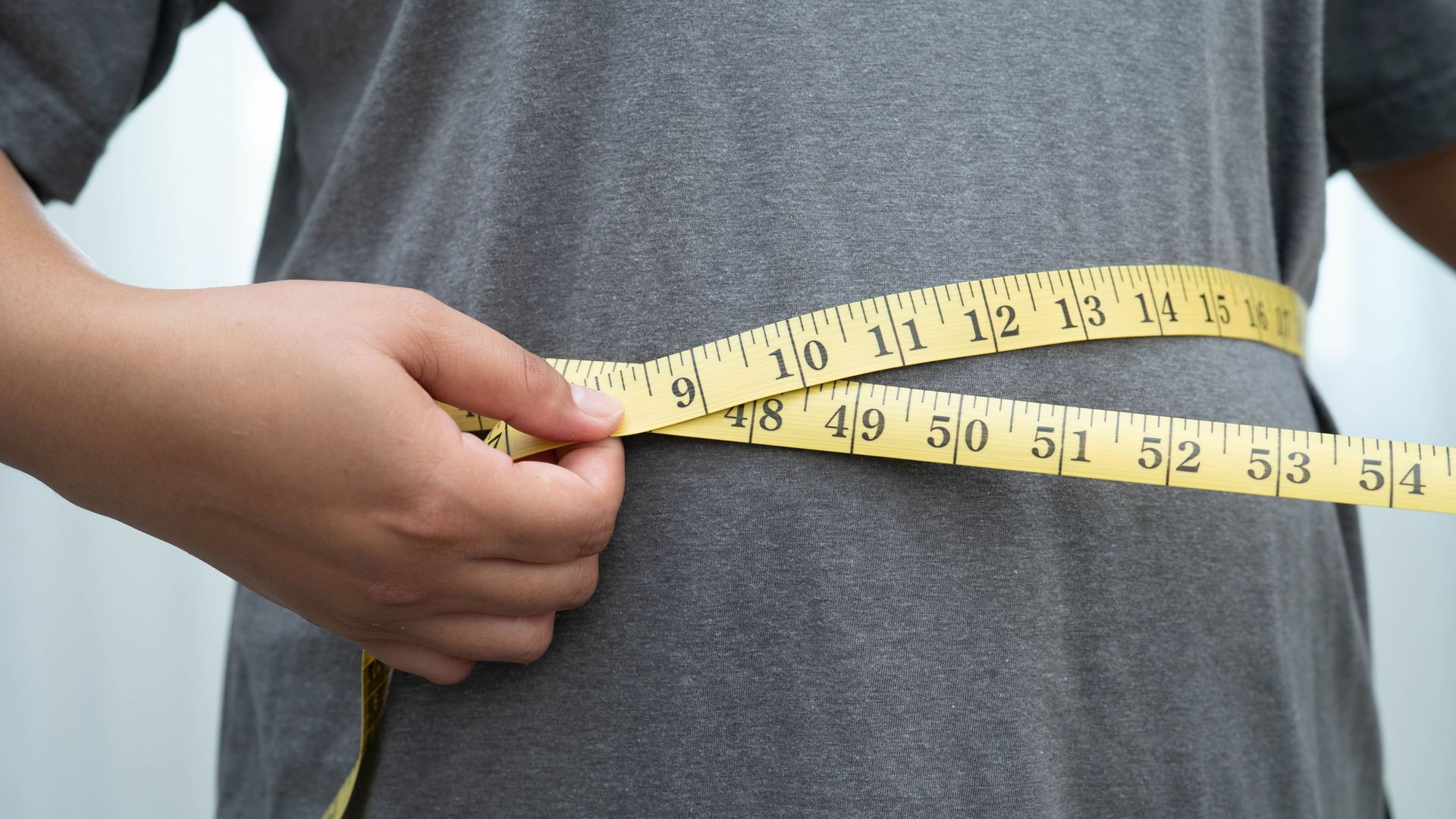
- Your waist measurement
- Any weight-related health conditions
- Your blood pressure or blood sugar levels
- How easily you can move and exercise
- How you feel day to day
- Your personal priorities
In fact, NICE recommends discussing personal goals alongside weight loss itself.² That could mean having more energy to do the things you enjoy or finding everyday activities and personal care easier.
For someone living with type 2 diabetes, better blood sugar control might feel like a major success. For someone with joint pain or sleep apnoea, being able to move or sleep more comfortably could matter just as much.
The number on the scales is useful. But it's only one part of the picture.
Do I need to reach a 'healthy' BMI before stopping?

No.
Body mass index (BMI) compares your weight with your height. Healthcare professionals use it because it provides a simple way to assess whether excess weight might be affecting your health.
However, BMI is not a perfect measure.
BMI doesn't directly measure body fat, for example. Nor does it tell us where you carry fat or fully account for differences in muscle mass and body composition.
More importantly, moving from one BMI category to another isn't what makes treatment successful.
Imagine somebody starts with a BMI of 40 and, after treatment, reaches a BMI of 32. They would still fall within the clinical obesity range. However, they may have lost a substantial amount of weight and experienced meaningful improvements to their health.
On the other hand, somebody who reaches a BMI within the 'healthy' range may still benefit from support to maintain their new weight.
So, while BMI can help you and your healthcare team monitor progress, there isn't a BMI number that automatically means it's time to stop treatment.
What if I've reached a weight I'm happy with?
Reaching your goal weight is a big achievement. But it doesn't necessarily mean the medication has finished doing its job.
Both Wegovy and Mounjaro are licensed for weight management, which includes maintaining weight loss as well as losing weight.³ ⁴
That's important because obesity is a chronic condition. Losing weight doesn't necessarily remove all the biological, environmental and behavioural factors that contributed to weight gain in the first place.
GLP-1-based medications help regulate appetite while you're taking them. Many people find they feel less hungry, become satisfied with smaller portions and experience less 'food noise'.
Once you're at a weight you're happy with, those effects may still be useful.
So, your healthcare team might decide that continuing treatment is appropriate, particularly if the medication is working well and any side effects are manageable.
On the other hand, there may be good reasons to stop. The important thing is not to assume that reaching a particular number means treatment automatically ends.
What happens if I stop taking Mounjaro or Wegovy?
Some people successfully maintain much of their weight loss after stopping treatment. However, research shows us that weight regain is common.
A large 2026 review brought together 37 studies involving more than 9,000 people who had stopped taking weight management medications. The researchers found that weight tended to increase again after treatment ended.⁵
We've seen the same pattern in individual GLP-1 studies.
In an extension of the STEP 1 Wegovy trial, participants had lost an average of 17.3% of their body weight after 68 weeks of semaglutide treatment. One year after stopping, they had regained around two-thirds of the weight they'd lost.⁶
That doesn't mean the same thing will happen to everyone. Weight regain varies considerably from person to person, and stopping treatment doesn't guarantee you'll return to your starting weight.
However, it does show why weight maintenance is important, as well as weight loss.
If you've reached your goal, it might be helpful to think about what has changed besides the number on the scale. Have you established eating habits you can stick with? Are you regularly active? Do you have a plan for dealing with increased hunger if it returns?
These things matter whether you continue medication or decide to stop.
Does a weight loss plateau mean it's time to stop?
Again, not necessarily.
Weight loss rarely follows a perfectly straight line. As your weight decreases, it's normal for the rate of weight loss to slow down or stop for a while.
Eventually, you may reach a point where your weight stays fairly stable. If you're happy with your weight and your health has improved, that stability may be exactly what you're aiming for.
After all, maintaining a significant weight loss is an achievement in itself.
If your weight has plateaued before you've reached your goals, that's a different situation. Your healthcare team can review your treatment, diet, activity levels and general health to understand why progress has slowed and whether anything needs to change.
What about NHS patients?
If you receive weight loss medication through the NHS, decisions about continuing or stopping treatment will follow NICE guidance and the pathway used by your NHS service.
These rules can vary depending on the medication.
For example, NICE uses the five percent weight loss threshold we mentioned earlier to assess how well treatment is working. There are also different recommendations around where particular medications can be prescribed and how long some NHS weight management services provide treatment.¹
These rules shouldn't be confused with a personal target weight. Losing five percent doesn't mean an NHS patient has 'lost enough' and must stop treatment. It's mostly to check whether the medication is producing enough benefit to continue.
Your clinical team will explain the rules that apply to your treatment and discuss what happens when you're approaching the end of it.
So, when should I stop GLP-1 treatment?
There's no single answer – and certainly no magic number on the scales.
Instead, it helps to look at your progress as a whole.
You and your healthcare team can consider:
- How much weight you've lost
- Whether your weight has stabilised
- Changes to your BMI and waist measurement
- Improvements in weight-related health conditions
- Your mobility, fitness and general well-being
- Whether you're still benefiting from the medication
- Any side effects you're experiencing
- Your personal goals and preferences
- How you'll maintain your progress if treatment ends
You might decide you've reached a healthy, sustainable weight and feel ready to manage without medication. Or perhaps you'll feel that continuing treatment gives you the best chance of maintaining the improvements you've made.
Neither decision comes down to hitting one particular percentage, BMI or goal weight.
Setting goals with Semapen
At Semapen, we know successful weight loss looks different for everyone.
That's why your treatment isn't based on chasing an arbitrary number on the scales. We'll help you set realistic goals and keep track of the things that matter to your health – from your weight to your daily mood.
Regular clinical reviews help you stay on track, too. We'll step in with advice or recommendations if it looks like you might need them. And if you're approaching your goal weight, we can help you think about the equally important next stage: keeping the weight off.
Do you want expert support with weight loss? You can get started today by taking a
quick online consultation. We'll let you know right away if you're eligible for a Semapen
weight loss programme.
Sources
1. National Institute for Health and Care Excellence (2025) Medicines and surgery: Overweight and obesity management [guidance]. Retrieved from
https://www.nice.org.uk/guidance/ng246/chapter/Medicines-and-surgery
2. National Institute for Health and Care Excellence (2025) Prescribing, reviewing and stopping tirzepatide [guidance]. Retrieved from
https://www.nice.org.uk/guidance/ng246/resources/a-guide-for-prescribing-medicines-to-manage-overweight-and-obesity-15299628589/chapter/Prescribing-reviewing-and-stopping-tirzepatide
3. Novo Nordisk (2026) Wegovy 0.25 mg, FlexTouch solution for injection in pre-filled pen: Summary of Product Characteristics [SmPC]. Electronic Medicines Compendium. Retrieved from
https://www.medicines.org.uk/emc/product/13799/smpc
4. Eli Lilly and Company (2026) Mounjaro KwikPen 2.5mg solution for injection in pre-filled pen [SmPC]. Electronic Medicines Compendium. Retrieved from
https://www.medicines.org.uk/emc/product/15481/smpc
5. West, S. et al. (2026) "Weight regain after cessation of medication for weight management: systematic review and meta-analysis"
BMJ, 392:e085304
https://doi.org/10.1136/bmj-2025-085304
6. Wilding, J.P.H. et al. (2022) "Weight regain and cardiometabolic effects after withdrawal of semaglutide: The STEP 1 trial extension"
Diabetes, Obesity and Metabolism, 24(8)
https://doi.org/10.1111/dom.14725
This article was reviewed and approved by Lujain Alhassan, Bariatric Nutritionist, on 12 October 2026.
- Average 15-21% weight loss*
- Tailored programmes built by real experts
- Targeted support to make success feel simpler
- Unique app with weight loss tools and lessons
Your journey starts here
Start your personalised weight loss plan in minutes.
1
Start your online consultation
2
Get approved by our clinical team
3
Begin your programme