
Mysimba vs Mounjaro: which weight loss drug is right for me?
Ready to take the next step? See if you're eligible for expert-led weight loss support.
Mysimba and Mounjaro both support weight loss, but they work very differently. Compare how you take them, how they work and clinical trial results.
If you're looking at prescription weight loss treatments, you may have come across Mysimba and
Mounjaro.
Both are licensed in the UK to help adults living with obesity or overweight lose weight alongside changes to diet and physical activity. But beyond that, they're very different medications.
Mysimba is a tablet that combines two drugs called naltrexone and bupropion. Mounjaro is a once-weekly injection containing tirzepatide, a medicine that mimics two naturally occurring hormones involved in appetite.
So, which one might suit you better? Let's compare how they work, how you take them and what the clinical trials tell us about weight loss.
Mysimba vs Mounjaro at a glance
| Mysimba | Mounjaro | |
|---|---|---|
| Type | Prescription tablet | Prescription injection |
| Active ingredient | Naltrexone and bupropion | Tirzepatide |
| How often? | Every day | Once a week |
| Full maintenance schedule | 2 tablets twice daily | 5mg, 10mg or 15mg once weekly |
| Main action | Acts on brain pathways involved in appetite and reward | Mimics GIP and GLP-1 hormones to reduce hunger and increase fullness |
| Average weight loss in key Phase 3 trial | 6.1% at 56 weeks¹ | 15% to 21% at 72 weeks, depending on dose² |
These numbers give us a useful idea of how the two treatments perform, but they aren't a head-to-head comparison. The trials were conducted separately, over different lengths of time and in different groups of people.
How do you take Mysimba?
Mysimba comes as a prolonged-release tablet. Rather than starting on the full dose straight away, you gradually increase the number of tablets over four weeks.³
The standard schedule is:
- Week 1: 1 tablet in the morning
- Week 2: 1 tablet in the morning and 1 in the evening
- Week 3: 2 tablets in the morning and 1 in the evening
- Week 4 onwards: 2 tablets in the morning and 2 in the evening
That means the usual full dose is four tablets every day.
The tablets should be swallowed whole and are preferably taken with food. They shouldn't be cut, chewed or crushed.³
There's also an early checkpoint built into Mysimba treatment. If you haven't lost at least five percent of your starting weight after 16 weeks, the UK product information says treatment should be stopped.³
How do you take Mounjaro?
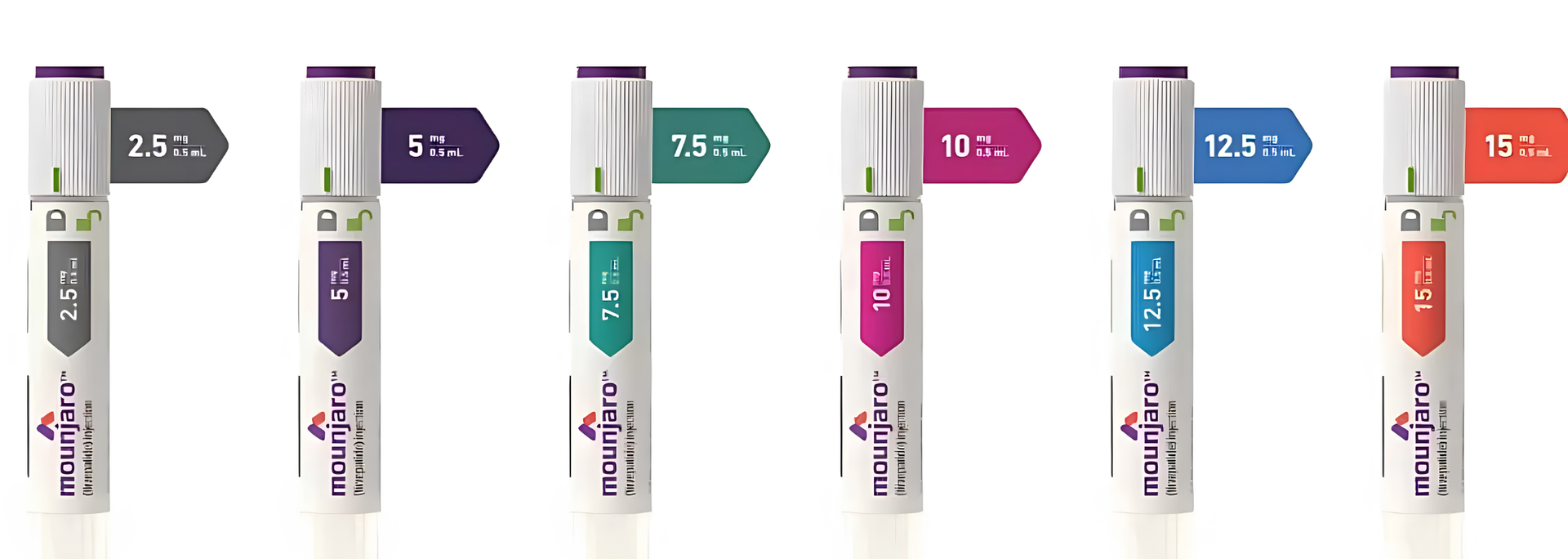
Mounjaro takes a very different approach. It's injected once a week using a pre-filled KwikPen.
Again, you don't begin at the full dose. The standard starting dose is 2.5mg once weekly for four weeks, followed by 5mg once weekly.⁴
If you need a higher dose, this can then be increased in 2.5mg steps after at least four weeks at the current dose. The recommended maintenance doses are 5mg, 10mg and 15mg, with 15mg being the maximum weekly dose.⁴
The gradual increase gives your body time to adjust and can help manage side effects.
From a practical point of view, the choice is quite different:
- Mysimba means taking tablets every morning and evening.
- Mounjaro means remembering one injection each week.
Some people will naturally prefer one approach over the other.
How does Mysimba work?
Mysimba isn't like Mounjaro, Wegovy or other GLP-1 medications.
It contains two active ingredients originally developed for other purposes:
- Naltrexone, which blocks opioid receptors
- Bupropion, which affects the brain chemicals dopamine and noradrenaline
Exactly how the combination suppresses appetite isn't completely understood. However, the two drugs appear to work together on parts of the brain involved in appetite control and the reward we get from food.³
In simple terms, Mysimba is designed to make it easier to eat less by reducing appetite and food cravings.
How does Mounjaro work?
Mounjaro works by imitating two hormones produced naturally in the body: GLP-1 and GIP.
Both are involved in what happens after we eat. Mounjaro activates their receptors, including in areas of the brain that regulate appetite.⁴
As a result, it can:
- Reduce hunger
- Increase feelings of fullness
- Reduce food cravings
- Help you feel satisfied after eating less
Mounjaro also delays stomach emptying, particularly earlier in treatment, although this effect reduces over time.⁴
This combination of effects can make it much easier to maintain the calorie deficit needed for weight loss.
Which is more effective: Mysimba or Mounjaro?
If we look at the major Phase 3 trials, Mounjaro produced substantially greater average weight loss.
In the COR-I trial, 1,742 adults living with overweight or obesity were given Mysimba or a placebo (dummy drug) alongside lifestyle support. After 56 weeks, participants taking the standard Mysimba dose lost an average of 6.1% of their starting weight. Those taking the placebo, meanwhile, lost 1.3%.¹
Mounjaro's pivotal SURMOUNT-1 trial included 2,539 adults with overweight or obesity who did not have diabetes. After 72 weeks, average weight loss was:⁴
- 15.0% with 5mg Mounjaro
- 19.5% with 10mg
- 20.9% with 15mg
- 3.1% with placebo
Those are much larger average reductions. However, there's an important caveat: Mysimba and Mounjaro haven't been compared directly in the same trial. SURMOUNT-1 also lasted 16 weeks longer than COR-I.
So, it's fair to say that Mounjaro has produced greater average weight loss in its clinical trial programme. It isn't fair to say that an individual will always lose three or four times as much weight on Mounjaro.
What about side effects?

Both treatments can cause side effects, particularly while your dose is increasing.
With Mysimba, the most common include nausea, constipation and vomiting. Dizziness, headache, insomnia and dry mouth can also occur.³
Mounjaro commonly causes gastrointestinal side effects, including nausea, diarrhoea, vomiting, constipation and abdominal discomfort. These are often most noticeable during dose increases and tend to become less common over time.⁴
Your medical history matters, too
Mysimba isn't suitable for people with certain conditions, including:³
- Uncontrolled high blood pressure
- A current or previous seizure disorder
- Bipolar disorder
- A current or previous diagnosis of bulimia or anorexia nervosa
It also can't be used by people who are dependent on opioid medicines.³
Mounjaro has a different set of precautions (it shouldn't be used during pregnancy, for example). Your prescriber will also need to consider any health conditions or medications that could affect whether treatment is suitable.⁴
That's why neither medication should be chosen on effectiveness alone.
So, is Mysimba or Mounjaro right for me?
It depends on what matters most to you and what's medically appropriate.
Mysimba might appeal if you strongly prefer tablets to injections. Mounjaro has the convenience of once-weekly dosing and, based on separate Phase 3 trials, produces considerably greater average weight loss.
But there are other questions to consider:
- Are you eligible for the medication?
- Do you have any health conditions that make one treatment unsuitable?
- Are you taking medicines that could interact with it?
- How do you feel about tablets versus injections?
- What side effects are you willing or able to manage?
- What are your weight loss and health goals?
A qualified prescriber can work through these questions with you.
Weight loss treatment with Semapen
Semapen doesn't currently offer Mysimba. We do offer Mounjaro, alongside other clinically supported weight loss options.
If Mounjaro is suitable for you, treatment comes with more than medication. You can:
- Track your weight using the Semapen app and connected smart scales (included in your programme)
- Work through expert-led Semapen Academy lessons
- With Gold and Platinum care plans, access a personalised digital fitness programme
Your clinical team can also keep an eye on your progress and offer advice if it looks like you're going off track.
Want to see whether Mounjaro could be right for you? To find out if you're eligible, all you have to do is take a quick online consultation.
Sources
1. Greenway, F.L. et al. (2010) "Effect of naltrexone plus bupropion on weight loss in overweight and obese adults (COR-I): a multicentre, randomised, double-blind, placebo-controlled, phase 3 trial" The Lancet, 376(9741) https://doi.org/10.1016/S0140-6736(10)60888-4
2. Jastreboff, A.M. et al. (2022) "Tirzepatide Once Weekly for the Treatment of Obesity" *The New England Journal of Medicine*, 387(3) https://doi.org/10.1056/NEJMoa2206038
3. Orexigen Therapeutics Ireland Limited (2026) Mysimba 8 mg/90 mg prolonged-release tablets: Summary of Product Characteristics [SmPC]. Electronic Medicines Compendium. Retrieved from https://www.medicines.org.uk/emc/product/2684/smpc
4. Eli Lilly and Company Limited (2026) Mounjaro KwikPen 10mg solution for injection in pre-filled pen [SmPC]. Electronic Medicines Compendium. Retrieved from https://www.medicines.org.uk/emc/product/15484/smpc
This article was reviewed and approved by Lujain Alhassan, Bariatric Nutritionist, on 12 October 2026.
- Average 15-21% weight loss*
- Tailored programmes built by real experts
- Targeted support to make success feel simpler
- Unique app with weight loss tools and lessons
Your journey starts here
Start your personalised weight loss plan in minutes.
1
Start your online consultation
2
Get approved by our clinical team
3
Begin your programme